Blog 5-Media Literacy

There are various benefits and risks for a public figure or person in a position of trust engages with a public audience in a media. One benefit is that media platforms expand the reach of public figures or people in positions of trust. Social media can be used as platforms to create their digital identities and disseminate important information to a wide range of audience, which paves the way for their future development. Also, engaging with a public audience allows them to establish credibility among their target audience. Establishing credibility is especially important for people in positions of trust because their career development is built on their credibility to some extent. By sharing their perspectives and achievement regularly, they can be trusted by the public. However, media platforms are a double sword for people in positions of trust because this credibility can be built or destroyed by media platforms. They have to be extremely careful about their statements and behaviors which are under the public’s supervision. Correspondingly, engaging with a public audience in a media reduces their freedom.

Negative replies and critiques are inevitable when engaging with a public audience in a media. In my opinion, it is important to stay calm and rational when encountered negative replies and critiques, and learn how to identify these comments. While some comments involve irrational attacks, there are some valid comments. In order to maintain the digital identity, it is necessary to demonstrate a willingness to address concerns or make improvements. Additionally, some of the negative comments might due to misunderstandings and therefore it is necessary to provide some explanations and clarifications.

One thing I noticed from the last week’s reading “Designing for open and social learning” was that while technological advancements provide a variety of resources for educators and learners, it is hard to guarantee the credibility of these resources. One benefit of having a PLN that values media literacy is promoting the credibility and accuracy of resources. It also helps individuals to improve several skills like critical thinking skills, summarizing skills and even problem-solving skills. In addition to understanding various content, it is also important to think critically about these contents and have your own opinion. Having access to a variety of resources allows individuals to gain exposure to multiple perspectives and, consequently, to discover a variety of solutions to problems. Moreover, a PLN that values media literacy has the potential to serve as a hub for professional development, providing invaluable resources and opportunities for networking to its members. Therefore, promoting the development of media literacy is beneficial to PLNs.

Blog 4-Inclusion and PLN evolved

I would like to choose educational institutions like UVic as the professional setting that I will discuss in this blog. Social media platforms have revolutionized communication by enabling instantaneous connections and extensive information sharing. Social media platforms like Twitter, Instagram and LinkedIn which our group talks about for the assignment are so powerful in disseminating information in today’s digital landscape. For instance, within expansive communities like UVic, comprising thousands of students and employees, social media serves as an indispensable tool for fostering inclusive and diverse messaging and themes. Effectively utilizing these channels can help educational institutions reach a wider audience and interact with a variety of people around the world.

Firstly, social media platforms facilitate the amplification of diverse voices, ensuring representation from students, faculty, and staff within such vast institutions, thereby fostering an inclusive and diverse campus environment. In addition to receiving different perspectives, these platforms serve as crucial channels for disseminating vital information to the intended audience. For example, the university uses social platforms to inform important decisions such as whether the campus is closed during a snow day, to faculty, staff and students Secondly, social media platforms play an important role in promoting events and activities. As an international student, I’ve personally relied on the UVic Instagram account for updates on various events and activities. Thirdly, social media platforms can be used to make advertisements. Universities can demonstrate their commitment to inclusivity and attract students from diverse cultural backgrounds by highlighting diversity-related scholarships and resources.

How would I create a PLN before engaging in a social media campaign on educational institutions? The first step involves selecting the appropriate platforms. Given the varying emphases of different social media platforms, I would like to choose a platform that is popular among educators and students and therefore I can build my network with them. I will also follow some popular influencers who work in my interested field or relevant field, and try to engage with their content to start building my network. Additionally, just like we have to share our perspective on each week’s topics through mattermost, it is important to participate in group chats to share my insights before engaging in a social media campaign on educational institutions. In sum, by building a PLN and using social media wisely, individuals can actively participate in educational conversations and make a meaningful impact in the field.

Blog 3-My Visitor & Resident Map

I think that the majority of students are using LinkedIn to develop their professional network. I believe this is the platform which is widely used by people to showcase their professional histories, and skills and make connections with others in the field. Another digital platform that students are currently using to develop their professional network is Twitter. Although Twitter is not originally designed as a professional network, some students are using it to make professional connections and share their insights. The idea of building a professional network online is pretty new to me because it is not prevalent in my culture. However, I do think that using digital platforms to develop a professional network offers more opportunities and possibilities.

One thing that students could consider is how to create and improve their digital identity when expanding their professional learning network. For example, just like a resume, it is important to select information that you want to include in your professional portfolio when building your network online through LinkedIn or Twitter. A strong portfolio will attract more people and therefore have more opportunities. In addition, when expanding your professional learning network, students may want to consider what they should say online. When compared with the speed at which information is transmitted in real life, how you communicate online reveals much about who you are. While building a PLN, it is imperative to keep your important personal data private and secure. Some individuals are not willing to share their personal or professional information online because of the concern of data privacy, and therefore they cannot fully engage in their network. Also, in some industries like medical care and clinical psychology, it is the professionals’ responsibility to protect patients’ information, which might limit the amount of information which could be shared online.

Inspired by my previous EDCI courses, one way to build a digital identity/ reputation is by creating a personal website or blog. By creating a website or blog, individuals can share more detailed information about their works, projects and skills. It is also easier for others to learn more about you rather than just looking at your LinkedIn profile which only provides limited information. Additionally, share your thoughtful ideas consistently through social media platforms like LinkedIn and Twitter. By sharing your ideas about the industry, you can attract people who have a similar interest to you and also reflect on your professional skills. Consistency contributes to creating a more favourable digital identity and keeps your followers more engaged.

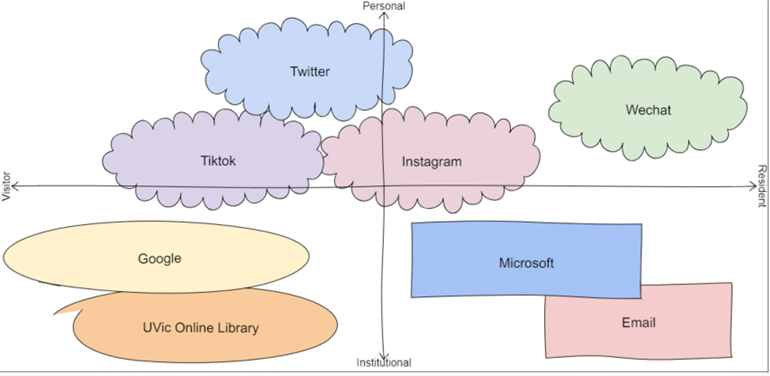
This is my resident & visitor map. Google and UVic online library are two tools that I use frequently without any personal interactions. Similarly, I use Microsoft and Email as two institutional tools, but I also actively participate in these two tools. For personal use, I’m more on the visitor side when I use Twitter and Tiktok because I usually do not post content or make comments. However, I’m a resident when I use Instagram and Wechat. I post my personal content and interact with my friends.

Blog 2-What Does My Digital Identity Look Like?

Before reading this week’s readings, I thought that digital identity only functions as the representation of who we are on the Internet through those social media platforms. Just like the way we built personal learning networks, we create our digital identity though sharing our ideas, exchanging ideas with like-minded people and therefore widening our networks. I didn’t realize that digital identity covers such a wide range of aspects in our life, which could even promote economic development. While you can create and manage your digital identity by yourself through social media apps, your digital identity involved in other services like financial services, health care services and government services cannot be managed by yourself. This reminds me of a practical and popular app in China, which is called “Alipay”. This app provides various services, and we can literally do everything by using this app. For example, we can buy goods, make payments, and use it for public transportation. However, before using this app, people have to create the account by linking the app to their identification card, which is an example of digital identity. During the COVID-19 pandemic, this apps provided a service called “health code”, which showed whether you test positive for corona virus. You must show this health code to access public areas at that time.

Although the use of digital identity benefits the access to many different service, it is important to make it inclusive, which is also a suggestion mentioned in the video of World Economic Forum. Just like the service of “health code”, it only benefits people who know how to use smartphones and create their digital identity, and becomes a big problem for the elderly and people who do not have smartphones. In addition to the issue of inclusion, the security of digital identity is also worthy concerning. Authentication plays a vital role in the development of digital identity, which prevents the disclosure of important personal information. For instance, the app that we are using for UVic account is “Duo Mobile”, a multi-factor authentication, which makes sure the account security. In summary, while it is important to develop the digital identity, it is equally important to ensure that it is inclusive as well as secure, which facilitates access and keeps personal privacy.

Blog 1-Personal Learning Networks

It was the first time that I heard of personal learning networks; however, after reading the readings, I realized that I’m involved in building my personal networks without knowing what it is. I have taken a few EDCI courses before. When I commented on my peers’ blogs and received comments from my peers or my professor, I was building this network. Networks are everywhere, and with the development and the dramatically increasing utilization of social media in these few years, people are building their networks through these platforms. I remember that in the last class of Co-op, we had to learn how to use and build our LinkedIn. The importance of building a network through social media is apparent. Compared to building the networks in real life, building the networks online gives people chances to contact more like-minded people, which could facilitate various aspects. Although they may come from different cultural backgrounds and have different careers, building personal learning networks using social media provides more opportunities for people both professionally and academically. Gaining more opportunities in careers and academics might be one of the reasons why people are motivated to participate in the networked public. Additionally, it enriches your perspectives on various subjects with contact with different people, which is hard to achieve in real life.

Just like personal learning networks, public communication offers more opportunities. Participating in public communications also allows useful information to be disseminated. As a student studying psychology, I gradually realized how important it is to disseminate important information, which helps researchers, practitioners and students have access to the latest research in the field. Additionally, public communication enhances the level of transparency. The public has the right to be informed about the latest updates, and with public scrutiny, the reliability of information is also increasing. Getting involved in public communications is beneficial; however, it also means that you will lose some personal privacy. In contemporary society, the disclosure of personal information is prevalent and needs attention. Another disadvantage is that the interpretation of information may affect the effectiveness of public communication. Each individual may interpret the information differently, which is likely to cause misunderstanding and the spread of misinformation.

Welcome and Introduction

Before proceeding with this first blog post, we expect you to consider your privacy preferences carefully and that you have considered the following options:

  1. Do you want to be online vs. offline?
  2. Do you want to use your name (or part thereof) vs. a pseudonym (e.g., West Coast Teacher)?
  3. Do you want to have your blog public vs. private? (Note, you can set individual blog posts private or password protected or have an entire blog set to private)
  4. Have you considered whether you are posting within or outside of Canada? This blog on opened.ca is hosted within Canada. That said, any public blog posts can have its content aggregated/curated onto social networks outside of Canada.

First tasks you might explore with your new blog:

  • Go into its admin panel found by adding /wp-admin at the end of your blog’s URL
  • Add new category or tags to organize your blog posts – found under “Posts” (but do not remove the pre-existing “edci338” category).
  • See if your blog posts are appearing on the course website (you must have the the edci338 category assigned to a post first and have provided your instructor with your blog URL)
  • Add pages, if you like.
  • Include hyperlinks in your posts (select text and click on the link icon in the post toolbar)
  • Embed images or set featured images and embed video in blog posts and pages (can be your own media or that found on the internet, but consider free or creative commons licensed works). To embed a YouTube video, simply paste the URL on its own line.
  • Under Dashboard/Appearance,
    • Select your preferred website theme and customize to your preferences (New title, new header image, etc.)
    • Customize menus & navigation
    • Use widgets to customize blog content and features
  • Delete this starter post (or switch it to draft status if you want to keep it for reference)

Do consider creating categories for each course that you take should you wish to document your learning (or from professional learning activities outside of formal courses). Keep note, however, that you may wish to rename the label of the course category in menus (e.g., as we did where it shows “Social Media & PL” as the label for the “edci338” category menu.Ā  This will enable readers not familiar with university course numbers to understand what to expect in the contents.

Lastly, as always, be aware of the FIPPA as it relates to privacy and share only those names/images that you have consent to use or are otherwise public figures. When in doubt, ask us.

Please also review the resources from our course website for getting started with blogging:

Test Social Media Post

This postĀ  will appear in a few places:

  1. in the blog feed on the front of your website
  2. in the Learning Design menu on your website. This is because we have applied the “edci338” category to this post and the menu item “Social Media & Personalized Learning” has been created from the category “edci338.” For every post you make for this course, please assign the “edci338” category to it. You are welcome to use this blog for your personal hobbies or for other courses, in which case, you could create additional menu items and categories for them.
  3. if you give permission, your posts categorized “edci338” will be aggregated onto the Blog Feed on the EDCI 338 Course Website.

Feel free to delete this post once you understand this. If you have any questions, please reach out to your instructor.