Month: February 2024

Blog 4-Inclusion and PLN evolved

I would like to choose educational institutions like UVic as the professional setting that I will discuss in this blog. Social media platforms have revolutionized communication by enabling instantaneous connections and extensive information sharing. Social media platforms like Twitter, Instagram and LinkedIn which our group talks about for the assignment are so powerful in disseminating information in today’s digital landscape. For instance, within expansive communities like UVic, comprising thousands of students and employees, social media serves as an indispensable tool for fostering inclusive and diverse messaging and themes. Effectively utilizing these channels can help educational institutions reach a wider audience and interact with a variety of people around the world.

Firstly, social media platforms facilitate the amplification of diverse voices, ensuring representation from students, faculty, and staff within such vast institutions, thereby fostering an inclusive and diverse campus environment. In addition to receiving different perspectives, these platforms serve as crucial channels for disseminating vital information to the intended audience. For example, the university uses social platforms to inform important decisions such as whether the campus is closed during a snow day, to faculty, staff and students Secondly, social media platforms play an important role in promoting events and activities. As an international student, I’ve personally relied on the UVic Instagram account for updates on various events and activities. Thirdly, social media platforms can be used to make advertisements. Universities can demonstrate their commitment to inclusivity and attract students from diverse cultural backgrounds by highlighting diversity-related scholarships and resources.

How would I create a PLN before engaging in a social media campaign on educational institutions? The first step involves selecting the appropriate platforms. Given the varying emphases of different social media platforms, I would like to choose a platform that is popular among educators and students and therefore I can build my network with them. I will also follow some popular influencers who work in my interested field or relevant field, and try to engage with their content to start building my network. Additionally, just like we have to share our perspective on each week’s topics through mattermost, it is important to participate in group chats to share my insights before engaging in a social media campaign on educational institutions. In sum, by building a PLN and using social media wisely, individuals can actively participate in educational conversations and make a meaningful impact in the field.
Blog 3-My Visitor & Resident Map

I think that the majority of students are using LinkedIn to develop their professional network. I believe this is the platform which is widely used by people to showcase their professional histories, and skills and make connections with others in the field. Another digital platform that students are currently using to develop their professional network is Twitter. Although Twitter is not originally designed as a professional network, some students are using it to make professional connections and share their insights. The idea of building a professional network online is pretty new to me because it is not prevalent in my culture. However, I do think that using digital platforms to develop a professional network offers more opportunities and possibilities.

One thing that students could consider is how to create and improve their digital identity when expanding their professional learning network. For example, just like a resume, it is important to select information that you want to include in your professional portfolio when building your network online through LinkedIn or Twitter. A strong portfolio will attract more people and therefore have more opportunities. In addition, when expanding your professional learning network, students may want to consider what they should say online. When compared with the speed at which information is transmitted in real life, how you communicate online reveals much about who you are. While building a PLN, it is imperative to keep your important personal data private and secure. Some individuals are not willing to share their personal or professional information online because of the concern of data privacy, and therefore they cannot fully engage in their network. Also, in some industries like medical care and clinical psychology, it is the professionals’ responsibility to protect patients’ information, which might limit the amount of information which could be shared online.

Inspired by my previous EDCI courses, one way to build a digital identity/ reputation is by creating a personal website or blog. By creating a website or blog, individuals can share more detailed information about their works, projects and skills. It is also easier for others to learn more about you rather than just looking at your LinkedIn profile which only provides limited information. Additionally, share your thoughtful ideas consistently through social media platforms like LinkedIn and Twitter. By sharing your ideas about the industry, you can attract people who have a similar interest to you and also reflect on your professional skills. Consistency contributes to creating a more favourable digital identity and keeps your followers more engaged.

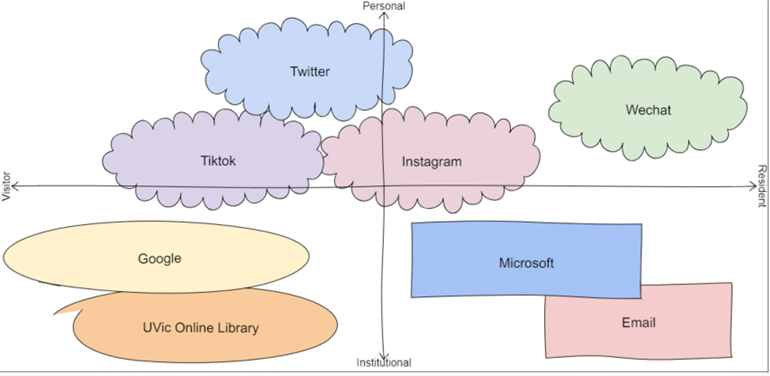
This is my resident & visitor map. Google and UVic online library are two tools that I use frequently without any personal interactions. Similarly, I use Microsoft and Email as two institutional tools, but I also actively participate in these two tools. For personal use, I’m more on the visitor side when I use Twitter and Tiktok because I usually do not post content or make comments. However, I’m a resident when I use Instagram and Wechat. I post my personal content and interact with my friends.